

In partnership with


Welcome, AI enthusiasts
GPT-6 is rolling out to everyone in ChatGPT, including free users. OpenAI is also adding Intelligent UI, so answers can include visuals and tools you can interact with inside the conversation. Ask for help planning a dinner, for example, and you could get a guest counter that updates how much food to buy as you change the numbers. Let's dive in!
In today’s insights:
OpenAI Drops GPT-6 and Intelligent UI Free for Everyone
Anthropic’s Drops Haiku 5.5
U.S. Government, Google and Meta Want to Build Virtual Cells
Read time: 5 minutes
LATEST DEVELOPMENTS
Evolving AI: OpenAI is bringing GPT-6 to free ChatGPT users alongside Intelligent UI, which adds interactive visuals and tools to your conversations.
Key Points:
Intelligent UI can explain complex topics through interactive diagrams and charts that let you change inputs and see what happens.
You can ask ChatGPT to build a savings calculator, bill splitter or playable game that works directly inside your conversation.
Free and Go users are getting GPT-6 Luna as the update rolls out.
Details:
ChatGPT can now help you plan a dinner with a guest counter that adjusts how much food you need to buy. The model decides whether those controls are useful or a plain text answer will do. You can start reading the response while GPT-6 is still thinking through the rest. In OpenAI’s tests, GPT-6 Instant began answering web-search questions 44% sooner than GPT-5.6 Instant on average.
Why It Matters:
OpenAI is making a stronger case for using ChatGPT even if you never intend to pay for it. People who have little interest in learning better prompts may find it easier to get things done when they can adjust an answer directly. That is a challenge for apps built around one simple task. If ChatGPT does the job well enough, there is less reason to open another app and learn how it works. As that convenience becomes a habit, OpenAI could gain more influence over the choices people see and the decisions they make every day.
TOGETHER WITH DATADOG
📈 The Engineering Leaders' AI Playbook

Evolving AI: Most engineering leaders are still making AI investment decisions on intuition.
Datadog's free AI Playbook gives you a practical framework to move from ad-hoc AI bets to evidence-driven systems, featuring priority plays, enabling capabilities, and a 90-day action checklist.
You'll get:
Four priority plays for turning AI investment into measurable business outcomes
How to keep humans in the loop as AI agents take on more of the work
A 90-day action checklist to move from ad-hoc AI experiments to repeatable, evidence-driven systems
MODEL LAUNCH
💰 Anthropic’s Drops Haiku 5.5
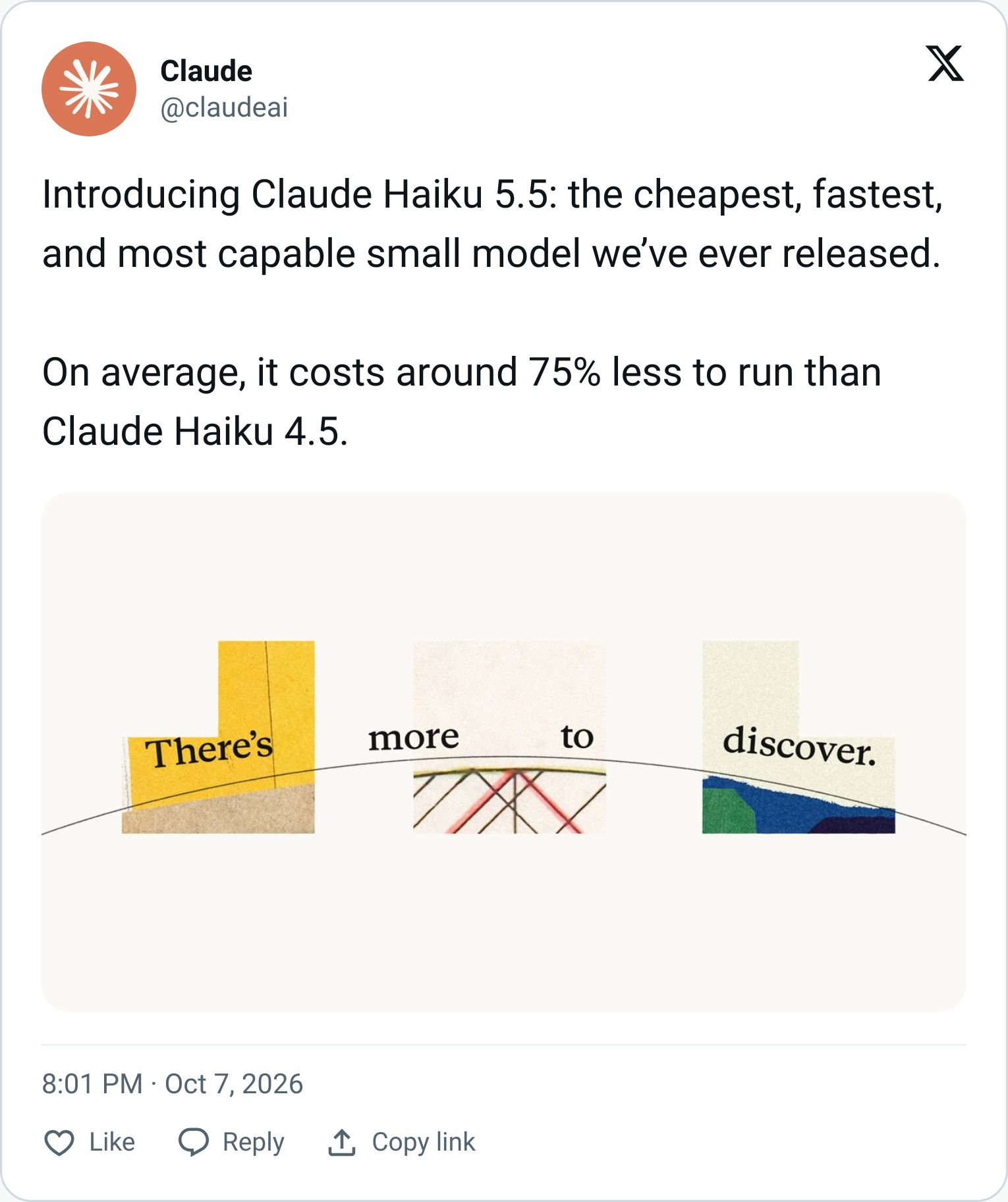
Evolving AI: Anthropic has released Claude Haiku 5.5 with better coding and computer use skills.
Key Points:
Haiku 5.5 is around 75% cheaper to run than Haiku 4.5 on average based on Anthropic’s estimates.
Haiku 5.5 scored 72.4% in Anthropic’s computer use test, ahead of GPT-6 Luna at 48.9% and Haiku 4.5 at 15.7%.
Haiku’s first adjustable effort setting lets developers give harder tasks more reasoning time and keep simpler requests cheaper.
Details:
Claude Haiku 5.5 can handle smaller assignments as a subagent while Opus 5.5 or Sonnet 5.5 manages the larger job. That means developers don’t have to pay for a larger model to handle every routine step. Anthropic has also reduced Sonnet 5.5’s pricing and estimates that most agent tasks will cost around 20% less. Haiku 5.5 is available now through Anthropic and major cloud providers.
Why It Matters:
Anthropic is giving companies a stronger reason to keep their AI spending within Claude. When an agent takes on a larger job, the smaller models doing the routine work can determine whether it is affordable to run every day. A better Haiku makes Opus and Sonnet more practical to use too, since companies can put them in charge of more work within the same budget. For buyers, there is a reason to look beyond a provider’s strongest model and consider what it costs to get an entire job done well. For smaller teams, that could make it affordable to automate more of the work they still have to do by hand.
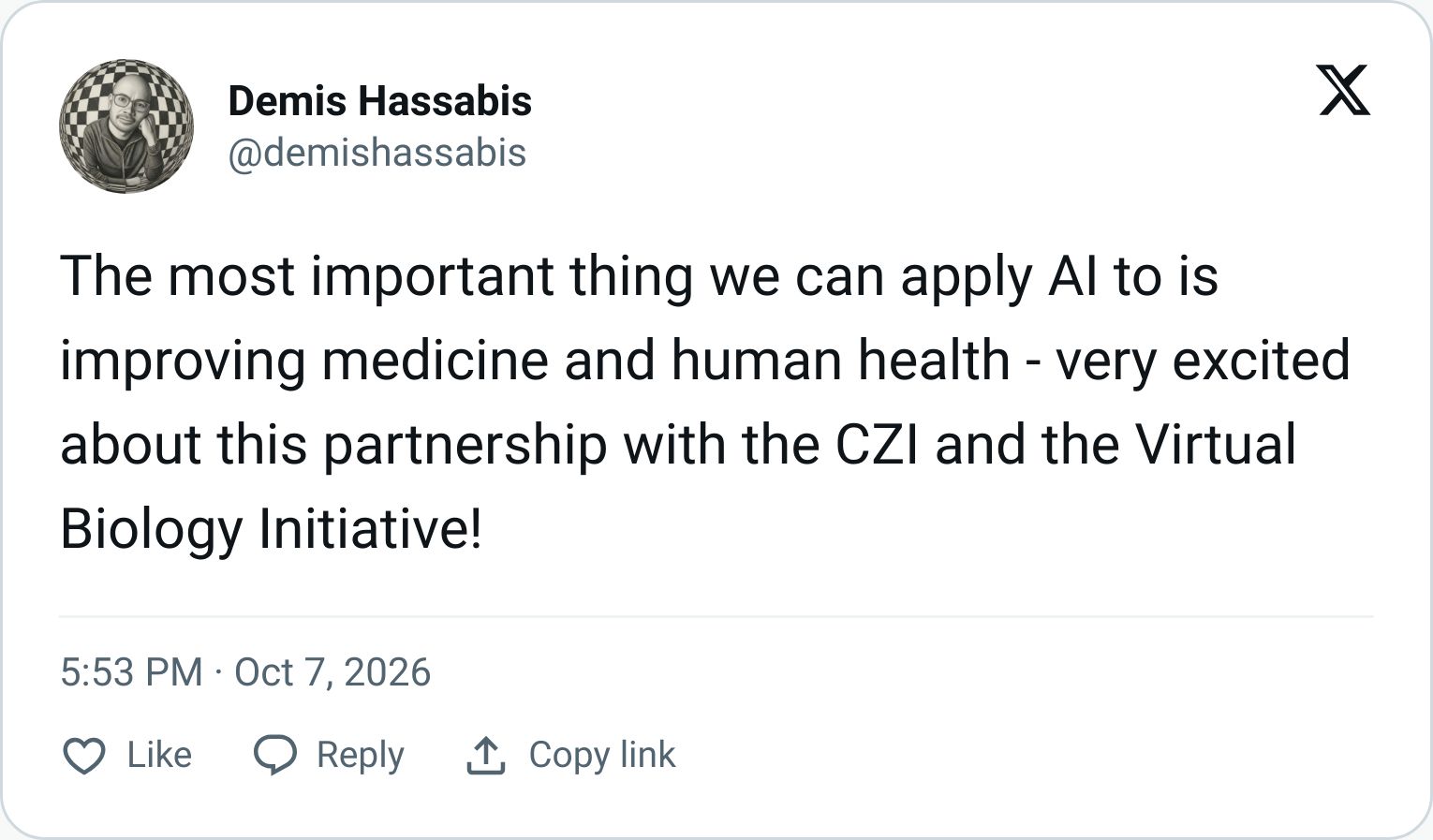
Evolving AI: Google, Meta and U.S. agencies have joined Biohub, backed by Mark Zuckerberg and his wife Priscilla Chan, in a $1.8 billion effort to help AI predict how living cells behave.
Key Points:
Scientists want to build a “virtual cell” so they can test how cells might respond to treatments before running physical experiments.
Google DeepMind, Meta and AI drug discovery company Isomorphic Labs are jointly contributing $300 million.
The U.S. Department of Energy will invest more than $500 million over five years in biological research and computing.
Details:
Zuckerberg’s Biohub is a nonprofit research institute collecting detailed images of cells and measuring how they respond to experimental changes. The plan is to combine data from different labs so scientists have a shared resource for training AI models. Those datasets will eventually be public, though commercial funders will get early access to some of them. The National Institutes of Health is contributing datasets developed through more than $500 million in earlier research spending, which Biohub will organize into a consistent format for AI training.
Why It Matters:
Google and Meta are funding the experimental work that AI needs to make better predictions about biology, and other major players are moving quickly too. In less than a month, Anthropic introduced its own biology lab and the OpenAI Foundation announced more than $125 million in grants for scientific datasets. These efforts suggest that a company’s ability to run good experiments and learn from the results could become a major advantage in AI biology. If the models become reliable enough, scientists could rule out an unpromising treatment before spending months testing it. Research teams would then have more time and funding for ideas they might otherwise never get to pursue. For patients who have few treatment options, the hope is that more promising ideas will get a fair chance.
👀 Click on the image you think is real


QUICK HITS
🔎 Google made SynthID Detector public, letting anyone check images, video and audio for AI watermarks from Google and partners.
💻 Microsoft and NVIDIA reworked Windows for agents, including local AI PCs and containers that isolate agent actions.
🎮 Google launched Playground, an experimental tool that turns simple text prompts into playable custom games with no coding.
🖥️ NVIDIA previewed DGX Station for Windows, with up to 748GB of memory for running trillion-parameter-scale models locally.
📈 Trending AI Tools
📝 Granola - AI notetaker that captures the real insights and turns every conversation into ready-to-share, action-driving notes*.
🎙️ Gemini 3.5 Transcribe - Google's most precise speech-to-text model yet.
🎨 Omniwork - Creative Agent OS where expert AI agents run your whole pipeline.
👤 Pluto - Turns your professional profile into an AI agent people can talk to.
*partner link
