

In partnership with

November 6, 2026 · READ ONLINE

Welcome back, AI enthusiasts.
Claude can now look at your bank transactions and help you figure out where your money is going. Anthropic is letting users connect their financial accounts to its AI assistant, making it easier to spot overlooked expenses and understand their spending. But would you trust AI to tell you what you can afford? Let’s Dive In!
IN TODAY'S ISSUE
01 Your Bank Account Can Now Talk to Claude
02 OpenAI Unveils GPT-6 Cyber Amid Global Cyberattacks
03 Meta’s Muse Is Now Taking Video Calls
01 / AI FINANCE
Evolving AI: Anthropic launched Personal Finance in Claude, letting users ask questions using their own bank data.
KEY POINTS
Claude can spot duplicate charges, unexpected fees, and rising bills, while creating personalized financial dashboards.
Claude can analyze up to two years of transactions alongside account balances and credit limits.
The beta is rolling out to US Pro, Max, and Ultra subscribers, with read-only access that cannot move or invest money.
DETAILS
Claude's finance hub lets you check what's left before payday or ask whether you can afford a trip. You choose accounts to connect through Plaid, which links banks to apps without sharing passwords with Claude. Finance-hub conversations aren't used for model training, and there are no sponsored recommendations. Anthropic warns balances may be outdated and calculations can be wrong.
WHY IT MATTERS
Claude could help you decide if a $500 purchase leaves enough for rent and groceries. If it overlooks a pending bill, you could face overdraft fees or miss a payment. As Claude and ChatGPT handle more financial questions, budgeting apps may need deeper planning and better safeguards to compete. People living paycheck to paycheck need to know when the numbers are too uncertain to trust.
It's time to set up your holiday streaming campaign

Are you ready to reach holiday shoppers on CTV? For many streamers, the season is already underway.
Last year, according to Roku internal data, holiday content searches on Roku saw an 86% increase during October. And in November, those searches rise an average of 39% weekly. This surging holiday spirit is mirrored by consumer activity, as about half of Roku streamers shopped Black Friday and Cyber Monday deals in 2025.
Meeting those shoppers is easier than you might think. Begin with the seasonal outcome you hope to drive: awareness, online sales, leads, store visits, or another measurable goal. From there, define your audience, upload your creative, set the budget and campaign dates, and establish measurement before launching. You can even create a shoppable ad unit that lets streamers buy with a click of their remote.
Our holiday playbook offers a month-by-month guide to reaching shoppers during this all-important time of year.
First-time spenders get a $5,000 match on the first $5,000 spent with code BEEHIIV5K. Terms apply.
02 / FRONTIER CYBERABILITY
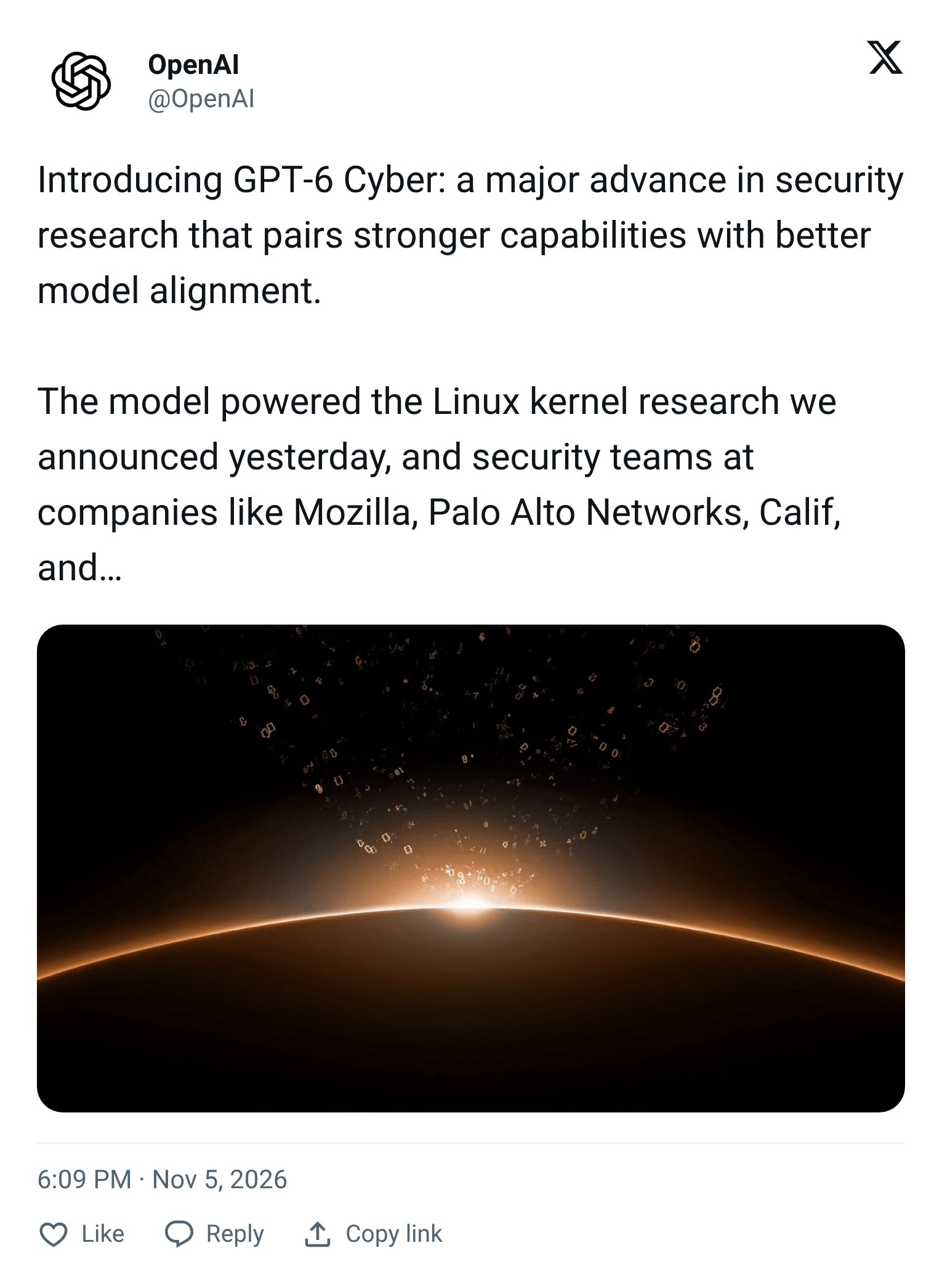
Evolving AI: OpenAI's GPT-6 Cyber enters the AI hacking race as AI-powered cyberattacks spread worldwide, bringing advanced capabilities to find and exploit security flaws.
KEY POINTS
GPT-6 Cyber found 81 previously unknown high-severity Firefox vulnerabilities, many already fixed by Mozilla.
It generated 948 working Linux exploits in controlled research and proposed security fixes.
On ExploitGym, it scored 48.5% versus GPT-5.6 Cyber's 32.1%, a 51% relative improvement.
DETAILS
OpenAI's GPT-6 Cyber, alongside other models, helped uncover weaknesses in OpenAI's AI training infrastructure, prompting patches and tighter network controls. OpenAI rates its cybersecurity capabilities as Critical and reports it stayed within authorized boundaries in 99.93% of one controlled evaluation. The model is initially available to select Daybreak Red customers through Codex and the API.
WHY IT MATTERS
Security teams could use GPT-6 Cyber to test whether flaws in browsers, banking apps, and workplace software are exploitable, then verify fixes before releasing updates. Faster patches could protect millions of users from data theft or compromised devices. CrowdStrike and Palo Alto Networks already use AI, but relying on models like GPT-6 Cyber could put OpenAI behind core features of their security products. Human experts must still validate findings and deploy patches safely.
TOGETHER WITH DATADOG

Evolving AI: Companies are pouring money into AI tools, models, and infrastructure. But there's one question many still struggle to answer: Is all that AI spending actually delivering a return?
Without clear visibility, costs can quickly spiral out of control, and inefficiencies often go unnoticed until the next cloud bill arrives. The good news? Kevel cut its AWS costs by up to $100,000 per month, proving how much of a difference better cost visibility and optimization can make.
Datadog's free guide explores how businesses can take control of their AI spending, uncover hidden inefficiencies, and connect costs to actual performance.
Here's what you'll discover:
Find out where your AI budget goes: See which models, providers, or teams are driving costs.
Catch expensive surprises early: Identify spending spikes before they turn into major bills.
Get more value from AI: Connect infrastructure costs to AI performance and make smarter investment decisions.
03 / AI COMPANION
Evolving AI: Meta’s Muse can now take voice and video calls, letting users talk face to face with an expressive AI avatar.
KEY POINTS
Muse can work on tasks during calls, with voice support for Meta’s AI glasses and Muse Charm planned.
Voice and avatars are rolling out to US users on mobile, web, and Mac.
Users can pick from hundreds of voices and use voice-only calls, a small avatar, or full-screen video.
DETAILS
Meta brings Muse to life using Realtime Voice for speech and Realtime Avatar to synchronize facial expressions and gestures. Users can interrupt Muse, brainstorm ideas, or rehearse interviews without typing. Meta reports 25 frames per second and roughly 870 milliseconds of response latency in research tests. Muse has expanded to Mexico, though calls remain US-only.
WHY IT MATTERS
Meta could give Muse an edge over ChatGPT and Gemini through its AI glasses and partnerships with Shopify, Walmart, Best Buy, and payment providers. Someone browsing a store could eventually ask Muse about a product, compare prices, and approve a purchase without taking out their phone. If these integrations work reliably, users could complete purchases without switching apps, giving Meta a bigger role in everyday shopping.
04 / HUMAN OR MACHINE?
One is real. Trust your eyes?
Two images. One photograph. Click the one you think is real.

A

B
05 / QUICK HITS
🎬 Google released Gemini Omni 1.2 Flash, creating editable 15-second AI videos for $0.07 per second at 720p, 30% cheaper than its predecessor.
🧠 Independent researchers at METR found Anthropic’s benchmark progress accelerated about 1.9× over the past year, with evidence that AI-assisted research contributed.
⚡ OpenAI pledged to pay the full power and infrastructure costs for its future owned data centers, while publishing local water, energy and hiring data.
🔎 Amazon launched Web Answer for Bedrock AgentCore, letting developers give AI agents a cited answer from live web sources with one tool call.
06 / TRENDING AI TOOLS
🤖 Lindy – The simplest way for businesses to create, manage, and share agents*.
🤖 Rerun - Turns ChatGPT or Claude subscriptions into scheduled AI coworkers.
🔐 Pinku - Runs private AI chats fully offline on iPhone and Mac.
☁️ Maritime - Gives AI agents persistent cloud computers, desktops and phones.
*PARTNER LINKS
BEFORE YOU GO
Worth your four minutes?
Help us make the next edition better.
See you tomorrow,
The Evolving AI team

